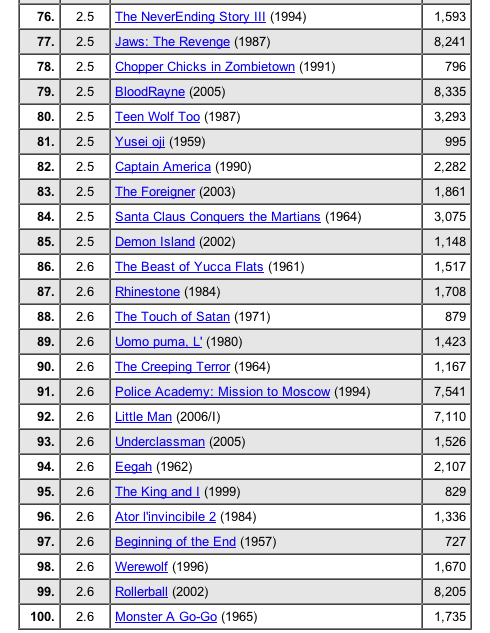
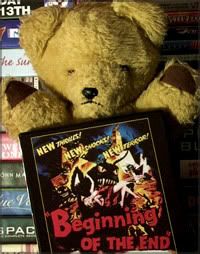
 From the man who brought you ‘King Dinosaur’ and ‘Earth vs The Spider’ I give you, ‘The Beginning of the End’. No, really – take it. With a title like that it would have been more fitting as the first film of this project. Anyhow, this was actually director Bert I Gordon’s second film, and an unfortunate sign of the type of films he would continue to direct. On February 1st 2007 it was placed at No.97 in the IMDB’s bottom 100 films, with an average score of 2.6, from 727 votes.
 The film opens with that well known tradition amongst American youths in the fifties. Necking in a convertible. Then continues with that staple Hollywood cliché of two youths necking in a car being attacked by something off screen. It’s a dubious start; maybe that’s what they should have called the film. ‘A Dubious Start’, starring Doug Squarejaw, and Heidi Fluff. I digress.
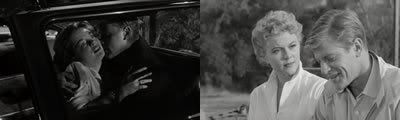
The plot gets quickly into gear as we follow Audrey Aimes - a journalist on the trail of a news story in the Arizona desert. She soon discovers that an unknown force has destroyed a whole town, and it’s150 residents are all missing. An engaging enough premise. Acting on a hunch she visits a nearby department of agriculture research station that is experimenting with food crops exposed to radiation. At this point I’m quite amazed that for a near half hour the film has been an entertaining enough little mystery. A little slow, but even the acting is of a higher standard that you’d expect from such a poorly rated film. However…
Whilst visiting a warehouse that was also recently destroyed, Audrey and the two agricultural scientists (Ed and Frank) encounter the menace responsible. A giant grasshopper. Welcome back to the world of questionable special effects, stupid questions, and that military bloke who just can’t believe it. The radiation link was just too obvious to ignore. As was the introduction of scientist Frank, who was deaf and mute due to an accident involving radiation. Thus only there to illustrate the dangers of their work. Although why he didn’t grow to be a twenty foot killing machine, as most other things do on contact with radiation in the 50s, I don’t know.
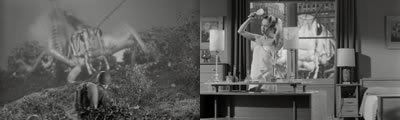
On seeing one of these giant grasshoppers/locusts, Dr Ed Wainright quickly scarpers and tries to call in the army. He doesn’t get very far, but from this brief contact he suddenly knows the grasshoppers numbers, average height, resistance to weapons, disposition. He’s the leading authority on giant radioactive grasshoppers. My biggest frustration at this point is that all the hopping action is described and alluded to through radio and phone calls between important looking people. Those bugs sure sound like formidable foes if they need an anti tank weapon to take them down, but I don’t get to see any of it.
When we do get to see some fighting it’s the usual superimposed army guys firing at a back projection of the bugs in super-sized close up. Being in black and white the joins aren’t too jarring all the time. They get them to climb up photos of buildings, and chuck them in a pool of water to emulate a lake. They’ve made an effort in places and occasionally it just about works.
Now let’s cut to the chase and say it’s basically a rip off of Them (1954) - minus the direction, atmosphere, effects, charm, you name it. It’s inferior in all respects. Peggie Castle put in the best performance as Audrey. Peter Graves, who would go on to play Captain Oveur in the Airplane movies, was okay as Dr Ed. Unfortunately neither managed to lift the largely mundane material. One of the most exciting moments was seeing Audrey’s car phone. Yes, a car phone in 1957. I had no idea they had been invented then. It was a hefty looking thing, but a cool prop.
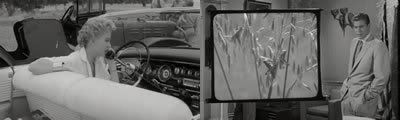
However cool a car phone may be, it doesn’t cover up the inconstancies in the plot. For instance a grasshopper later being easily killed by a handgun, or why they all seemed to stay together rather than spread across America. Actually that might have been addressed in the obligatory bug education portion of the film. Where Doug Squarejaw predicts doom from in front of a slide projector. If so, it has already been excised from my mind, as has the majority of the rest of the film.
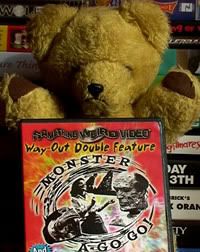
I would have been more favourable toward Beginning of the End if it hadn’t have been so dull. Regardless of the hopeful start, even at just 73 minutes long I found myself clock-watching toward the end. At least with a movie like Monster A Go-Go you can laugh along with the silliness. Whilst entertainment here is severely limited by a highly predictable and linear storyline, that quickly fizzles out of ideas.
For the information of insect lovers – some grasshoppers died in the making of this movie. What began as 200 grasshoppers reduced to just a dozen after they started to cannibalize one another. I wouldn't be surprised the same situation occurred amongst cinema goers stuck in a darkened room watching this film.
So far:
Best film – Monster A-Go-Go (1965)
Worst film – Rollerball (2002)

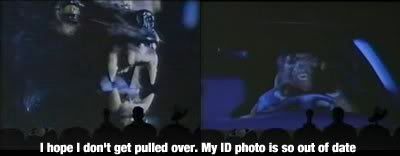
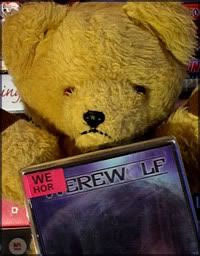 On receiving an old VHS copy of Werewolf, I was impressed by the hologram cover of a man turning into a werewolf. However, after starting to watch the film I worried that the special effects on the box would be better than those in the actual film. My worries weren’t entirely unfounded.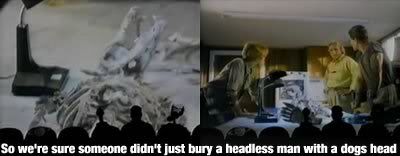
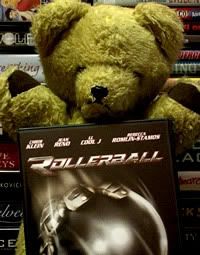 Well, this is quite a difference from the last film. Bringing us right back into the present decade. On February 1st 2007, Rollerball was placed at number 99 on the IMDB’s bottom 100 films, with an average score of 2.6 out of 10, and 8,205 votes. That’s a very high number of votes for the bottom 100, strengthening its position there, and showing just how badly this film has been received.
 And so it begins.
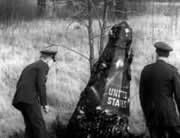 As far as I can tell, the majority of what we see in the final product is Rebane’s footage. The story concerns a failed manned rocket mission to investigate unusual objects orbiting the Earth. The rocket crash lands, the astronaut is missing, and there is a giant humanoid monster on the loose killing people. It appears the monster is a mutated version of the astronaut with a heavy dose of radiation, able to contaminate those that get too close. In other words, been there, seen this, but never so badly made. It’s really just a rehash of The Quatermass Experiment (1955), but with none of the atmosphere and a far less coherent plot.
 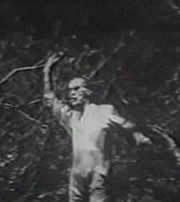 The other most notable thing on show is the monster itself; played by Henry Hite, who stood at an impressive 7 foot 6 inches tall. Although the movie blurb says the monster is 10 foot tall, and so he is shot from a low angle to try and make this believable. Hite’s monster is suffering from some form of radiation mutation that causes cheap latex to get stuck to his face. He wanders about his scenes looking more confused than terrifying. The rest of the cast is quite frankly utterly forgettable. Even the characters are forgettable. Most don’t even warrant a name, and simply get referred to as ‘driver’, ‘helicopter pilot’, ‘girl’, ‘boyfriend’. Not just in the narration, but in the dialogue too.
  Hello. My name is Jaune Heatley, and I am a writer and director for Bear & Beyond. Hopefully you will enjoy some of my offerings in the near future. In addition to that I am undertaking a shameless attempt to encourage extra funding for Bear films, by taking a look at the state of human films over the years. I will be reviewing every film on the IMDB bottom 100 list. Being a fan of low budget and most genre movies I will not prejudge these films because of their status. What I’m looking to see is whether they deserve to be where they are.